
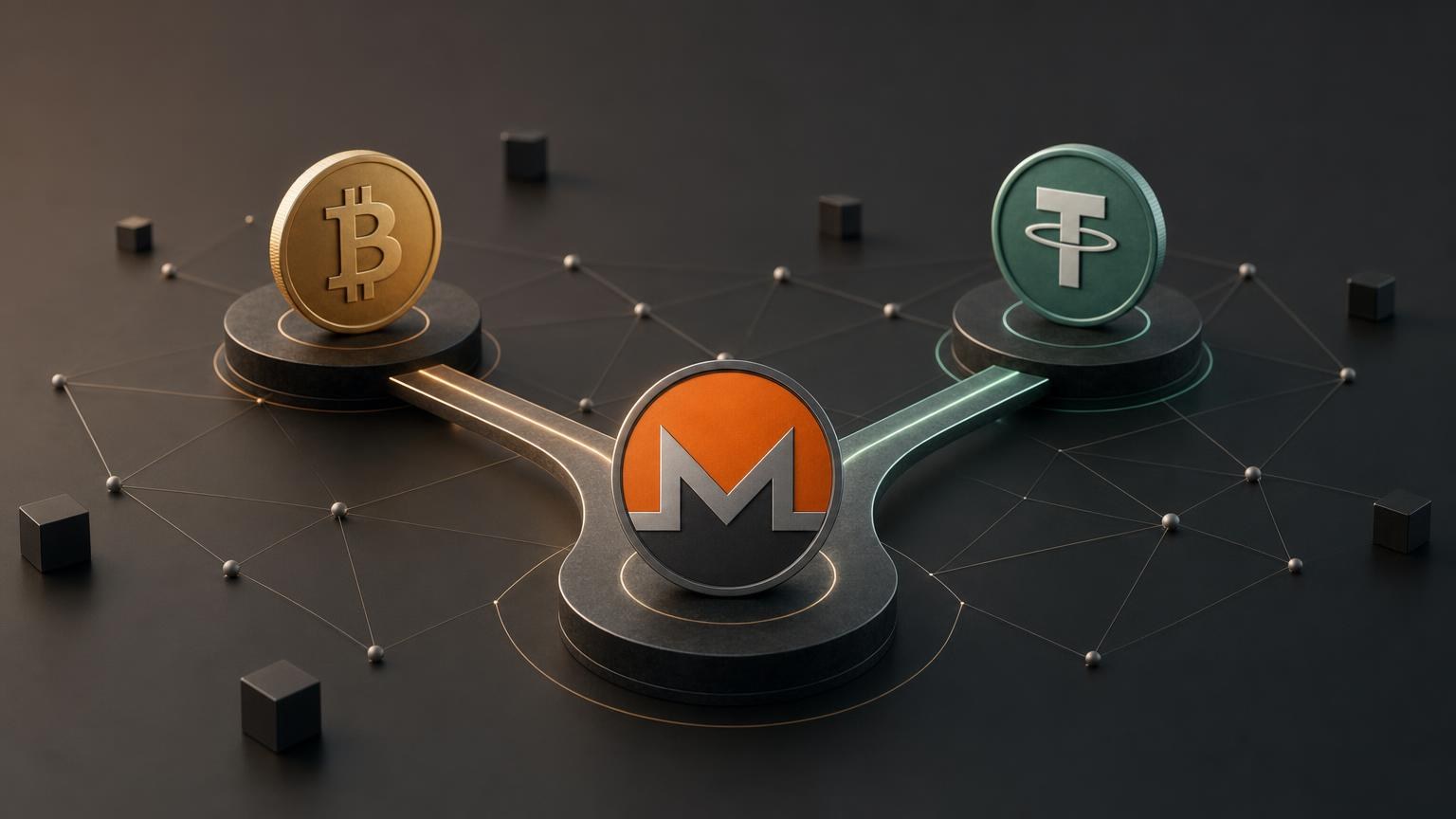
Choosing between XMR to BTC and XMR to USDT starts with the destination, not with a headline exchange rate. Both routes sell the same input asset—Monero—but they deliver outputs built for different jobs. BTC provides exposure to Bitcoin and settles on its native blockchain. USDT aims to track the US dollar and can exist on several distinct blockchains, so “USDT” alone is not a complete destination.
What should actually be compared?
A useful comparison keeps the XMR amount and the observation time consistent, then examines what arrives after all quoted deductions. The practical figure is the net output: the BTC or USDT expected at the receiving address under the displayed conditions. A nominally attractive rate may be less useful if it requires an unsupported network, falls outside a limit, or does not fit the next transaction.
Separate stable properties from changing ones. Bitcoin uses a public ledger in which transactions can be independently verified, while Monero hides transaction details through privacy-focused protocol features. USDT is a token issued on multiple blockchains rather than a single native network asset. [1]
By contrast, the available route, exchange quote, service charge, network cost, minimum or maximum amount, required confirmations, and estimated processing time are dynamic. They need to be checked when creating the order rather than copied from an older example.
Stop criteria: when a route is immediately unsuitable
Apply hard constraints before comparing prices. If a route fails any mandatory condition, a better-looking quote does not rescue it.
- The recipient requires a specific asset. A BTC-only payment request rules out USDT. A USDT-denominated obligation rules out BTC unless another conversion is acceptable.
- The receiving wallet does not support the output network. This is especially important for USDT because the ticker can represent tokens on different blockchains. Tether publishes separate protocols for its tokens and notes that protocol support can change. [2]
- The destination address cannot be independently verified. Crypto transfers are generally not designed for card-style reversals. Bitcoin guidance explicitly warns users to verify the complete address before sending. [3]
- The amount is outside the current limits. Do not split or enlarge a transaction until checking whether the displayed limits, fees, and compliance conditions change with the amount.
- The route is unavailable in the relevant country or under the required compliance conditions. Verification requirements can depend on the direction and the results of compliance checks. Local rules may also differ.
- The recipient cannot use the asset after receipt. Receiving USDT without the native asset needed for a later network fee can leave the tokens temporarily impractical to move. Receiving BTC is equally unhelpful if the next platform accepts only a particular USDT network.
The two comparable routes
XMR to BTC: direct exposure to Bitcoin
This route converts XMR into Bitcoin’s native asset. It fits a task that explicitly calls for BTC, a Bitcoin-compatible wallet, or continued participation in the BTC market. Bitcoin transaction records are public, unlike Monero’s confidential transaction model, so the privacy characteristics of the input asset do not carry over unchanged to the output chain. [4]
The main constraint is price exposure. The BTC amount received remains denominated in BTC and its value against the US dollar or another currency can move after the exchange. That may be intentional, but it is unsuitable when the purpose is to keep a relatively stable dollar-denominated balance for a near-term payment.
Settlement expectations also require a live check. A broadcast Bitcoin transaction is not the same as a sufficiently confirmed payment, and recipients may apply different confirmation policies based on risk and transaction value. [5]
XMR to USDT: dollar-referenced settlement with a network choice
This route converts XMR into a token designed to maintain a value linked to the US dollar. It can be more aligned with budgeting, quoting a crypto payment in dollar terms, or moving value to a platform that uses USDT as its settlement asset.
The network is part of the asset description. USDT on one blockchain must not be sent to a deposit that supports only another implementation unless the receiving service explicitly provides a compatible cross-chain process. Tether’s documentation lists multiple protocols and asks integrators to state clearly which ones they support. [2]
“Stable” does not mean risk-free or identical to holding dollars in a bank account. Stablecoin market prices can depart from their reference value, while redemption, issuer, reserve, custody, and secondary-market conditions introduce risks that do not apply to a native asset in exactly the same way. [6]
Constraint-Based Decision Matrix
| Criterion | Meaning for the task | Which route passes or fails | Material limitation | What to verify before deciding |
|---|---|---|---|---|
| Required output asset | The recipient, wallet, or next platform specifies BTC or USDT | The specified asset passes; the other route fails unless another conversion is acceptable | An extra conversion adds another quote, transfer, and operational step | Exact deposit asset and accepted destination format |
| Need for dollar-referenced accounting | The amount must remain easier to express in US-dollar terms | USDT is designed for this purpose; BTC does not target a dollar peg | USDT can deviate from its reference value and carries issuer and redemption risks | Current market quote, platform acceptance, and relevant stablecoin conditions |
| Intentional BTC exposure | The user wants to hold or spend Bitcoin after leaving XMR | BTC passes; USDT fails that specific objective | BTC’s value against fiat currencies can change before the next use | Net BTC output and personal tolerance for price movement |
| Destination network compatibility | The output must match the receiving wallet or deposit network exactly | BTC passes only with a supported Bitcoin destination; USDT passes only on the selected supported token network | Matching the ticker while mismatching the network can cause loss or difficult recovery | Network name, address, wallet support, and any required destination details |
| Ability to make the next transfer | The received asset may need to be moved again | Either can pass if the wallet supports the asset and its fee mechanism | Some token transfers require a separate native network asset for fees | Required fee asset and current network conditions |
| Privacy expectations | The user expects Monero’s on-chain confidentiality to continue after conversion | Neither route should be assumed to preserve the full XMR privacy model | Bitcoin has a public ledger; USDT networks may be publicly traceable, while the exchange process can create additional records | Destination-chain visibility, data requested by the service, and wallet practices |
| Current execution conditions | The route must be available and economically practical now | Either may pass or fail at order time | Quotes, limits, fees, liquidity, network load, and verification requirements change | Final receivable amount, rate validity, limits, status, and compliance terms |
How one constraint changes the answer
Consider a user who needs to pay a BTC invoice. The asset requirement ends the comparison immediately: XMR to BTC is the relevant route even if USDT appears easier to value in dollars. Changing only one condition—replacing the BTC invoice with a USDT deposit accepted on a named network—reverses the result.
In another case, the destination platform accepts both assets. If the priority is retaining deliberate exposure to Bitcoin, BTC fits the requirement. If the priority changes to preserving a dollar-referenced amount for a near-term purchase, USDT becomes more aligned, provided the platform and wallet support the same network.
A third scenario starts with a preference for USDT but no compatible receiving network. That is a stop condition, not a minor inconvenience. BTC may then be operationally usable if the destination accepts it, or the transaction may need to wait until a compatible USDT address is available. There is no universal winner because changing one binding constraint changes the valid route.
After identifying the route that fits the destination, check the currently available XMR routes and output networks before creating an order. Support for XMR, BTC, and USDT does not imply that every pair or token network is available at every moment.
Final checks before sending XMR
- Confirm that the order says BTC or the exact required USDT network—not merely the expected ticker.
- Copy the destination from the receiving wallet or platform and compare the entire address. Do not rely only on its first and last characters.
- Check the net output, quote validity, limits, network charge, and any service charge displayed for this specific order.
- Review the current verification conditions before transferring funds. Requirements may depend on the route and compliance results.
- Use the requested XMR payment details exactly. Monero’s public blockchain does not expose payment information in the same way as Bitcoin, and proving a payment to a third party may require transaction-specific data from the wallet. [7]
- Save the order details and transaction identifier. Do not share seed phrases, private keys, or wallet access with anyone claiming they are needed to complete the exchange.
- Check local legal and tax rules if they apply to the transaction; treatment differs across countries and may depend on individual circumstances.
The disciplined choice is therefore simple in method, even when execution details vary: eliminate routes that fail the destination, asset, network, compliance, or usability requirements; compare the remaining options by their current net output; then verify every address and network field before making the irreversible transfer.

Buymassager is a certified wellness specialist and health technology reviewer with over 12 years of experience testing therapeutic devices. As someone who personally manages [relevant condition like plantar fasciitis/neuropathy], they bring both professional expertise and real-world insight to product evaluations. Their work has been featured in [Health Magazine/Wellness Blog/Medical Review Site],
0 Comments